Expand your World
Today, I am interviewing the brilliant David Arditti from my Astronomy Club, Writer, Composer, Astronomer, Lifelong Learner. His is an internal migration story. It’s a long interview, but worth the read.
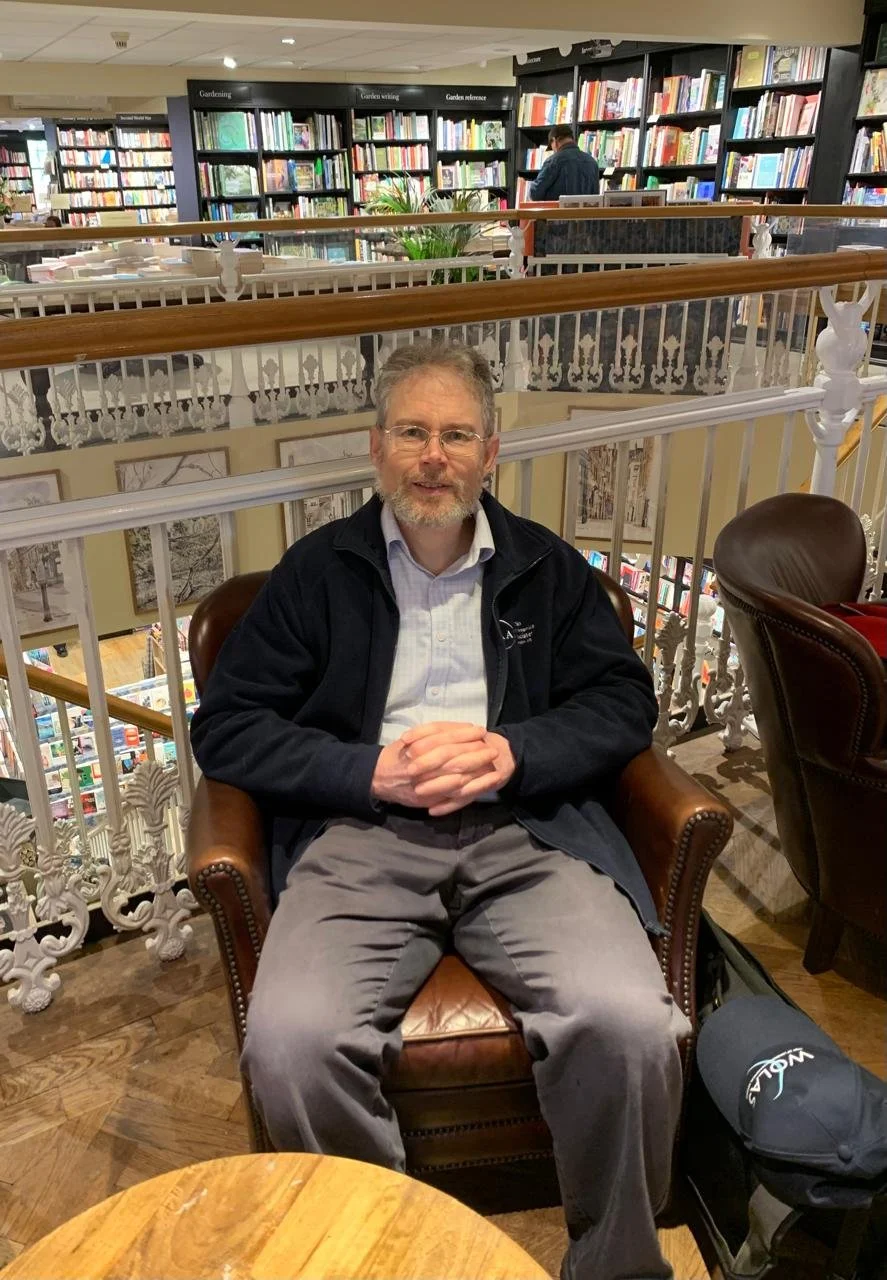
Exploring the café at Waterstones, Hampstead
You were born in Bournemouth and you live in North West London now. You mentioned you moved to London at the age of 18. What motivated the journey?
My family isn’t from this country at all, and the two sides are different. My father’s family is Jewish, in England since the late 19th century, and always in the same business of selling carpets. They came from Turkey, and set up the business in London, but moved it to Bournemouth during the Second World War. My father was sent to school nearby in Dorset.
My mother came from Italy, a tiny farming village in the high Alps, right on the Austrian border, where her mother tongue was German. She has died now, but could speak Italian and English as well. Her family was part of the German population of that region, transferred into Italy as war reparations under the Treaty of Versailles in 1919. So there’s a big community there which is culturally German or Austrian, but Italian by nationality. She came to England and worked as an au pair for my father’s mother, and that’s how they met.
My father’s family was very anglicised. They were determined to be very English, and he was sent to a very English public school. I was born in Bournemouth, but shortly afterwards, he left his mother’s carpet business and started his own in the next town along the coast, Christchurch, where I went to school. It’s a small, nice town, about 50,000 people, but it felt like quite the backwater. It’s mostly a place for retired people. There’s an airport there now, some aviation and defence industries, and a bit of fishing, but most young people don’t tend to stay there.
I applied to various universities that were closer home, such as Southampton University, which is the closest, but I did not get in there. I got into London University, in a college called Westfield College. At the time, Margaret Thatcher, who was Prime Minister, had decided to amalgamate smaller universities and colleges into bigger ones. I was one of the last people taken on to do Physics there. I think they took on more students than usual that year, even if they didn’t get top marks in the A levels, but didn’t have accommodation for them all. First years normally expect that from universities far from their hometown, and this was longer than 100 miles from Christchurch. I had to find my own through the student union. Some students hadn’t worked that out and had to get beds on the library floor. So I moved to London to study Physics, BSc at Westfield College, University of London. Westfield has since merged with Queen Mary College and is now known as Queen Mary University of London. And I stayed on really because I made friends and connections in London.
You graduated in Physics, you’re a composer, writer and cyclist. When you introduce yourself, where does astronomy feature on the list?
It depends on who I’m talking to. I normally say I’m an amateur astronomer because I’ve never been paid to do astronomy research. Although I’ve written a lot about it, I’ve not done it as a profession. My line has been more writing about astronomy, giving talks for adult and sometimes children's education, and administering societies because, unfortunately, I’ve got quite a lot of common sense. Scientists or astronomers often don’t have much common sense. They are clever but impractical, and it’s quite difficult to find people to run organisations that have employees and large assets, money in the bank to invest, and many volunteers to negotiate with. It’s difficult to change the policies, because you have to get everybody to agree to it. Since most of them are unpaid, they can just walk away if they are not happy with something. I’ve been very involved with West of London Astronomical Society (WOLAS) and British Astronomical Association (BAA), and I became President of BAA, which is the largest astronomy group for amateur astronomy in the UK. I spent a lot of time running voluntary organisations and doing unpaid stuff.
I was surprised to see the word ‘amateur’ attached to someone with your body of work, you’ve been president of BAA, you’ve written books with Patrick Moore, who’s himself a major figure in this field.
Patrick Moore was very influential on me and on several generations of people like me. He was on the television for, believe it or not, about sixty years once a month and was a very popular figure. He was such a friendly man, and when you met him, he’d always invite you down to his house. That wouldn’t happen today. I couldn’t invite these children down to my house, but that’s what you did, and there was nothing sinister about it. He was just really enthusiastic. He wanted to tell everybody about astronomy, and he enthused hundreds, maybe even thousands of young people to either become professional astronomers or amateur astronomers or other types of scientists, mostly boys I would say. I think he didn’t get along with girls so much. He had a very boyish personality even as an old man. He was like an over-enthusiastic school boy, and that’s why school boys really liked him. He wrote hundreds of books. I’ve bought and read most of them. I met him at meetings, and he loved talking to young people and helping them. I didn’t have a grandfather. Both of my grandfathers died long before I was born. He was like a grandfather figure to me.
Do you think his enthusiasm for the subject is still alive in amateur astronomy today? He once called it the best of all hobbies.
I think it is, though the nature of it is changing. He belonged to a world of drawings and note-taking. I’m very keen to get these children in school in our astronomy club to do the same, draw what they see and make notes the traditional way. That’s what amateur astronomers did. They kept records of what was happening in the sky, recorded things that professional astronomers missed, and often made discoveries. There’s less of that now. It’s all becoming more electronic. A lot of amateur astronomers spend a lot of time taking pictures of the same things and not really discovering anything new. They get very involved with computers and technicalities, but it doesn’t have the same homespun DIY quality that it used to. We used to make our own telescopes, what we are doing in this club of course, but that’s unusual now. We are doing it as an educational exercise, but people would seriously make their own stuff to do research.
I think it aids your memory, doing something hands-on.
It certainly does. Making drawings aids the memory. I follow Patrick Moore’s advice that you should learn a different constellation every night and make drawings of constellations. The things I learned using his method when I was about 13, I still remember. But things that I didn’t learn at the time, I can’t remember, even though I’ve read them in books many times since.
My introduction to Astronomy
Did your interest in astronomy help you connect with other Londoners or migrant communities? I’ve realised a lot of hobbies that I thought were solitary aren’t really so.
You can certainly do it as a solitary hobby, and I’m sure there are a lot of people like that, but I don’t meet them very much because they are solitary, obviously. Back when I was starting, you had to join a society to get all the details because there was no internet. Some of the daily newspapers had columns on what was in the sky, but for things that changed from night to night, say you wanted to know the position of planet Venus, you had to join a society for information, and read their weekly newsletters. The BAA, for instance, publishes a magazine every other month and a book every year with details on where to find objects in the sky, the timing of eclipses, conjunctions and those kinds of things. You really had to join an organisation to get that information. Today, you can just Google it. It’s a very different world.
Which year are you talking about?
The 1980s, though it started to change in the 1990s. I joined a society at about 13 or 14. My father had a business friend in the Wessex Astronomical Society in Dorset. He introduced me, and they were very friendly and let me look through their telescopes. I got hooked looking through an amateur astronomer’s 12-inch telescope at Planet Saturn, the moon, and some other objects. It was a really big telescope, particularly for that time. I can still remember exactly what Saturn looked like. You could see all the moons, and it was so amazing that I wanted my own telescope. I wanted to read all about it and join their society.
But I also had a long gap. After my physics degree, I decided to study music part-time, in evening classes, and for about twenty years, I wasn’t involved in astronomy at all. It was only when I moved in with my partner Helen, who had a house in North West London with a big garden, that I thought it might be a good place to observe the sky from. I got out my old telescope, which I’d bought when I was in school, and set it up. Then I joined WOLAS and re-joined BAA.
Since you spoke of music, is your interest in music and astronomy in any way connected? Your compositions draw on poetry and folk traditions rooted in feelings and memory, while astronomy is enormous, fixed, and almost the opposite.
That’s a question I get asked a lot. And strangely enough, the answer seems to be completely no. There is no connection. I know composers who want to write pieces of music inspired by astronomy, but I have never done that. It seems kind of passe to me, like it’s been done already. I think it is sort of connected to the philosophy of art really, the philosophy of music. I think that music is completely abstract. I think it doesn’t represent anything.
That reminds me of the Preface to The Portrait of Dorian Grey, where Oscar Wilde famously says in the end, ‘All art is quite useless’, similar to the philosophy you just mentioned, that art is by itself, it’s just supposed to be.
Yes, there are famous pieces of music that are supposed to be connected to astronomy. The only really famous one is The Planets by Holst, but he was inspired by the mythology connected to the planets, not the physics. He opens with Mars Bringer of War, because of its red colour in Greek Mythology. People often ask me why I don’t write a piece of music inspired by the constellations, but I don’t because the planets have already been done. You are not going to write a better one than Holst. You could do the satellites, I suppose, the constellations of the Zodiac, or the 88 constellations in the sky, but those are far too many, it gets silly. Maybe I will do it one day. I think that art and science are the opposite sides of a piece of paper, they don’t touch. They exist in the same world and in some sense, have the same basis, exist in the same minds, but I don’t think one creates the other in either direction. When people think they do, they are just using their imagination in a creative way.
Take another example of music that everybody knows, Vivaldi’s Four Seasons. It has four pieces representing winter, spring, summer and autumn. But if nobody told you which was which, if you played it, say, to an African Tribesman who never had any contact with European Civilisation, he wouldn’t know which one was autumn. These are imaginary associations. I think music is abstract, it’s absolute, It doesn’t represent the things it’s supposed to represent, even in a famous case like that.
You are talking about instrumental music, right? As soon as you introduce lyrics, it becomes different.
You are right. Then you’ve got a song, you’ve got poetry, then obviously it connects to the other things.
Do you think different sciences correlate with different arts?
In my experience, a lot of mathematical scientists, like astronomers and physicists, are very keen on music, particularly classical music. And you find a lot of classical musicians interested in the physical sciences. Whereas people in the biomedical sciences, such as doctors, tend to be more into literature, drama and the theatre. There are exceptions, but I think there is a parallel between music and mathematics. Music is about proportion. The notes are in a certain frequency, and harmony is built up in particular ratios, the Harmony of the Spheres as phrased by Pythagoras in ancient Greece. Kepler who discovered the laws of the planetary motion and built the Kepler telescope, was very keen on this idea and believed he could prove that the distances of the planets were in similar ratios to the pitches of music, which isn’t quite the case, but people have always believed in these connections between mathematics and astronomy and music. It doesn’t apply to books so much.
So there’s your answer for why you get asked the question so often.
I think people with a mathematical bent of mind are dawn to music and tend to be good at it. I’ve even met classical musicians who have abandoned that career and gone full-time into science because it’s very hard to make a living in music. It’s precarious. It’s difficult to get a stable income unless you teach, which a lot of musicians do as well.
Is yours a pure passion for music that makes you continue with it?
Yes. Gustav Holst, when asked why he composed, said something like he didn’t compose until the idea he had became more annoying not to write down than to write down. That happens to me as well. If I have an idea bothering me, writing it down becomes less of an effort. It’s a funny way of putting this, but its easier to do than not to do. I expect artists in other fields feel the same way, they have to paint that painting, they have to write that poem.
It’s also a way to not forget, to capture inspiration when it strikes, or find it through the act of doing.
I chair a group called the London Composers Forum, I’ve been a member for about twenty years, and chair for about ten. We organise concerts and teach each other about different aspects of music and composing. I meet a lot of composers, and they are all different. Some of them find it difficult to come up with ideas, and they need a stimulus, say being prompted to write about planets, or Venus, or Jupiter, or have a system to compose. I’m not like that. I get a lot of ideas, but I don’t finish them. I lose interest halfway through. So I have hundreds of ideas, and they are all written down, but they are just scraps, brief notes and not finished pieces that anybody could play. And I turn those scrappy notes into finished pieces only 1% of the time.
You could collaborate with people who need ideas. I think ideation is the difficult step, which is partly why AI worries me, because now everyone is outsourcing thinking, and that ability will only get scarcer.
I don’t really like systems per se, in any art. I believe in doing it intuitively. It's useful to have a wide knowledge of music produced in the past and take from it what you can, and follow your own instincts. I don’t believe in composing to a pattern or system. You can use a system, which is almost like painting by numbers, filling your own colours here and there, but the structure has been pre-determined by some mathematical formula or pattern. Some composers really like to do that. They want things to be determined scientifically by some formula, but I don’t.
I think that’s so interesting and also contradictory to something that we were discussing earlier about how Mathematics and Music are connected through patterns of ratios and proportions, whereas you are saying that it needs to be more abstract, more intuitive. It need not be part of a system.
I think the reason for that is that there are many levels of what you might call texture or detail in any work of art, and you can have patterns on one level but randomness or artistic decision-making on another. I don’t want to find pitches between the twelve notes of the conventional Western scale. You can construct music with all sorts of inventive pitches that you create between the notes of the scale, but I’m quite happy to stick with the twelve notes that already impose a Pythagorean pattern on music, and have those natural ratios built into it. It has mathematics on that level, but I don’t believe that I should write a piece of music with 12 bars in one theme, 16 in the next, 64 in the next, in some predetermined ratio. Some composers do work that way. You can also have different levels of the structure, some more randomised than others. In the end, you can do what you like. We are not driving a train. It’s just music, it’s not going to kill anybody (quite the contrary). The worst that could happen is that people are just going to get bored and walk out.
You mentioned one of the reasons you got back to astronomy was because you moved to NW London, decided the skies were clear and brought your telescope. Were there unique challenges that London’s light-polluted atmosphere presented to stargazing? Do you think where you currently stay is the best place for it?
Obviously not. I would prefer to be in the countryside or by the sea, but my partner Helen wants to stay in London because she’s got a big family and quite a few of them live in London, and she likes visiting her mother at least once a week. So she wants to stay in London, and she’s quite determined about that. So I do my best from a very poor location.
What makes it poor?
There is a lot of light pollution, and it increases every year. I mostly concentrate on observing the brighter objects, planets like Venus, Jupiter, Mars, the Moon, or even the Sun with a solar filter. You can also see a surprising number of fainter objects, like comets, with a large telescope. You can take images of them with sensitive cameras. And with modern processing power, you can do a lot to remove the light pollution interference from the images of the sky. Obviously, it’ll never be as good as images taken from a dark place, but you can do a lot. That’s really why I concentrate on Jupiter, because it’s not affected by the light pollution. What you want for Jupiter is a steady atmosphere, or what we astronomers call good seeing, which is how sharp the images are when you look through a telescope. The image is always being disturbed by rising and falling currents of hot and cold air, which interfere with the light part, and defocus and split up the light. But sometimes we get good seeing, and the image is stable.
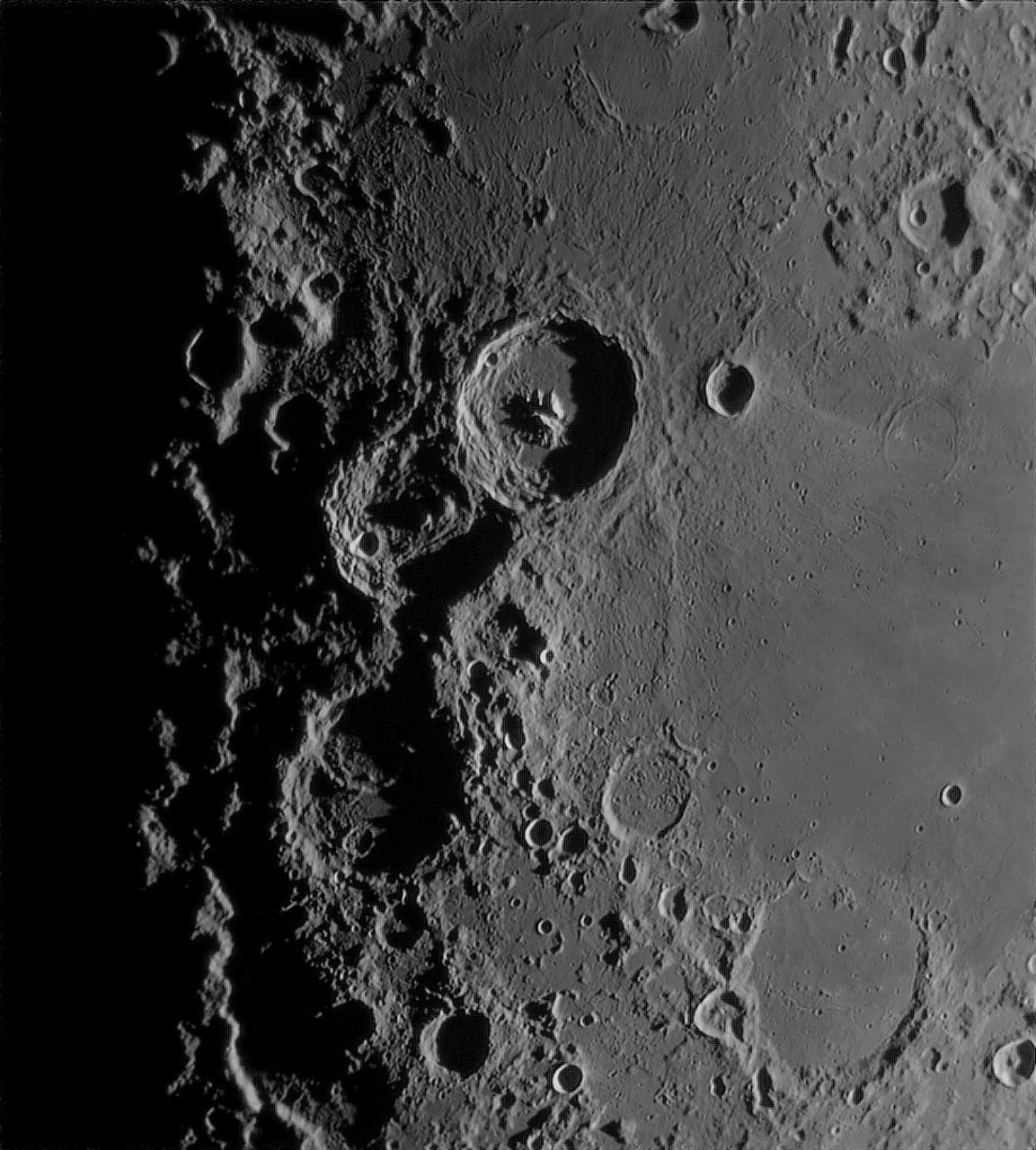
Craters Theophilus, Cyrillus and Catharina on the Moon, taken on 22 April 2016.
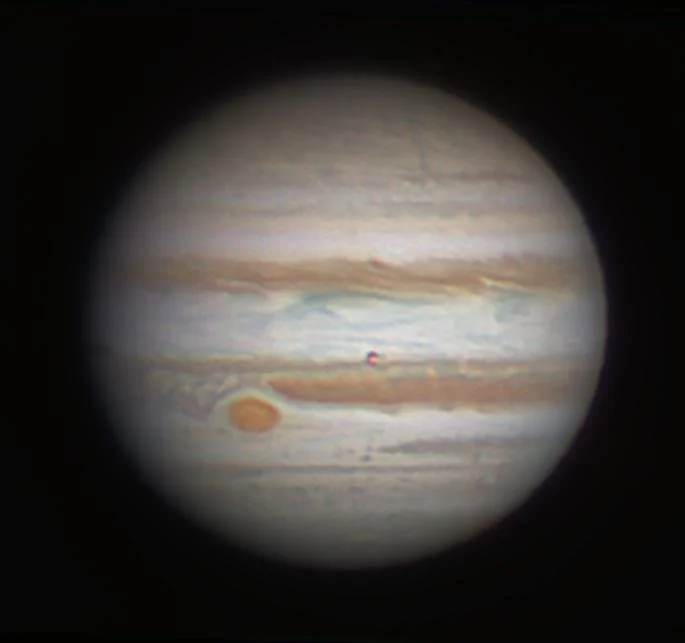
Jupiter with its moon, lo, in front of it, taken on 2 April 2026. Both images taken by David with a 14-inch aperture telescope.
If you go out every night, then a proportion of the nights will be very good, so it’s just a matter of persistence even in a bad location. If you persist, you can get the right occasions to make observations. Besides, for Jupiter, Venus, Saturn, Mars, light pollution doesn’t really make any difference. You can get good results from a large city.
Speaking of a large city, has London’s physical landscape changed since you first arrived?
Yes, it’s become much denser. Where I live now in Outer London, it’s becoming more like Inner London, it’s changed a lot in 23 years. It used to be old, little detached and semi-detached houses with big gardens and a certain amount of industry in between. Now the industry is mostly gone, and big block flats are being built everywhere. It’s becoming more densely populated. The gardens tend to get built on. The community shifts all the time. The area that I lived in, before I got there, in the 1960s-1970s, had a large influx from South Asia of Indian people. The white English people tended to move out into Hertfordshire or Essex. When I moved there, only the very old generation of white people in their 70s, 80s, and 90s were still living there. Then in the 1990s and early 2000s, Tony Blair’s government welcomed the East Europeans, and we got a big wave of East European immigration, and they are still there. So now, it’s very mixed in Outer North West London – big South Asian community, lots of East European communities, not many white people. They have tended to move out into the outer suburbs like Watford, places further out.
There has also been a repopulation of Central London and Inner London. I lived for about twenty years in West Hampstead, which was, I wouldn’t say down at heel, but quite lower-to-middle class. You could get a lot of cheap flats there, lots of students and young people there. Hampstead always had wealthy people, but West Hampstead didn’t. Since then, the area has become more upmarket. It’s full of bookshops, as we are sitting in a bookshop today, and ethnic delicatessens and craft shops. It’s become much more upper-middle-class, and there’s been a repopulation of professional white people, mostly white people, some of them European, Jewish, back into Inner London.
Given you have seen these different communities arrive and shift over time, do you think they are well integrated now?
I think they are extremely well integrated. Whenever we have racial tensions in the UK, when people try to make trouble, it’s rarely in London. There have been incidents, like the Brixton riots years ago, others more recently, but in the last twenty years, the communities in London have mostly been peaceful.
There’s also been this effect of separating out. Often, working-class white people have left of their own accord, and it’s complicated. The reason to a certain extent is that they have been priced out of Inner London, or the accommodation wasn’t available. The big houses that they needed to bring up their families tended to be blocked. The houses get occupied by somebody living on their own. The rest of the family has moved away. My father is like that. He’s occupying a house that is much too big for him, and nobody’s living with him, and it’s a big family house, but he’s going to live there until he dies, he’s determined to do that, and I’ve seen that a lot. I think in the 80s-90s, probably early 2000s, this shortage of accommodation for families growing up in London pushed a lot of people to the Home Counties, and immigrants from Asia, Africa, Eastern Europe, who had been cramming their families into smaller spaces, occupied those freed-up properties. So I think it's more about housing shortages than people actively deciding they didn't want to live near certain communities, though that effect exists too, to some extent, along with effects of where the jobs are. So when I say that things are harmonious in London, it’s also because people got out of the way of each other.
I think that the places where the far-right parties do well tend to be the places that don’t have much immigration. People are just afraid of something they haven’t seen. In London, Birmingham, Manchester, the really big cities, where people have been mixed up racially for a really long time, they are much less worried about these things. It’s also partly a class issue. More upper-class and upper-middle-class people are less worried and more secure in their jobs. It was the white London working-class that was always afraid of immigrants from West Indies, Africa, Asia taking the lower-level jobs like driving buses, driving taxis, collecting rubbish, and now working in healthcare. They were worried about being undercut in terms of wages. My partner Helen is disabled, so she takes a lot of taxis, and the taxi drivers we meet, I think of them as typical working-class English people. I don’t meet many of them, but they are the closest I tend to meet, and they usually have very right-wing views. They are anti-immigration, and they have moved to places like Essex or Hertfordshire because they like it there. There aren’t many immigrants there, many black and brown people, and I think that represents certain kinds of tendencies.
Those would probably be the ones who voted for Brexit, though that’s a whole different conversation.
Yes, we saw this division in a big way. People in small towns and rural areas voted for Brexit, people in the larger cities voted against Brexit.
Sorry, that went off tangent. I have one last question. If there is someone who has never looked through a telescope, and they ask you why they should, what would you tell them?
It gives you an idea of the scale of the universe and the scale of time. I find that people who have studied astronomy have a different attitude to time. You realise not only how short human life is, but how short the life of the whole species is, how short the life of the whole planet is, how short the life of a star is. It gives people a different perspective on existence really, and on the need to care for our own planet, our communities, to protect the environment. I can look through my telescope at Venus and see a planet very like the Earth but completely uninhabitable. It’s uninhabitable because its carbon dioxide atmosphere has driven a greenhouse effect that's pushed the surface temperature to 400°C. That’s where Earth is headed if we carry on like we are. It’s a scientific certainty, and it’s not going to take very long either. I don’t have children, but my brother does, and I’m worried for the next generation. They’ll see an environmental catastrophe, which is entirely foreseeable and could be averted.
Astronomy really shows you what the universe is. It shows you the timescale, the distance scale and how hostile the rest of the universe is, and how special the Earth is. I mean, you don’t need to look through a telescope, you could study the subject and find out all these things anyway. But the experience of seeing things with your own eyes helps to put these understandings deeper in the brain, I think, and consciousness. I think understanding astronomy is important for people to understand our place in the universe, our smallness in the universe, our smallness in the scale of time, and the fragility of all human existence and think about some of the things that are needed to preserve human existence in the future.
That’s such a wonderful answer because it puts a lot of other problems and their magnitude really into perspective, the things people squabble over.
Exactly, and all the people who have been to space say that it gives you a different perspective. You can see how small everything is, and it’s all in one tiny place in the universe, and that’s everything and everybody who has ever existed and ever been known and ever will know, and it’s fragile. It’s unbelievably fragile when seen from the outside.
Thank you David!
You are welcome and thank you very much for your intelligent and thoughtful and interesting questions.
