Sharing an old favourite below.
“The problem in the world today is that we love our boys and we raise our girls.” Michelle Obama
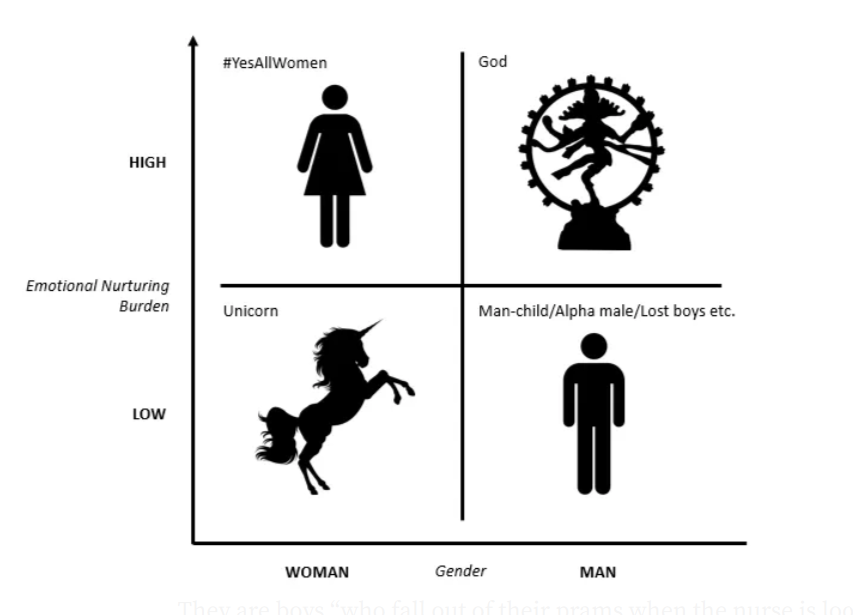
This is a work of fiction. Any resemblance to actual persons, living or dead, or actual events is purely tongue in cheek.
There’s a trope in literature best illustrated in Peter Pan — the Lost Boys. They are boys “who fall out of their prams when the nurse is looking the other way and if they are not claimed in seven days, they are sent far away to the Neverland” where Peter Pan is their captain and where they become boys who never have to grow up. In popular culture, it is the trope of the man-child.
These boys require a Wendy, someone who can nurture and guide them out of their perpetual stage of childhood. In a family unit, you’ll see similar roles donned by the mother and father figures. The majority of mothers take the responsibility of bringing up the child, often playing bad cop, while the fathers are left free to play best friend and good cop.
Though the supervisor might not always be female (Jeeves in Wooster and Jeeves), the bumbling but good-intentioned, harmless and unworldly subject is almost always male. Perhaps it’s a natural consequence of protecting and giving free reign to our men, to a point that they feel entitled, and simultaneously pushing our women to be emotionally mature and perfect.
Ron has Hermione, to teach him how to not have the emotional range of a teaspoon; Ved has Tara, to make him realise he’s more than what he thinks he is; Akash has Shalini, to make him believe in the existence of love; and Mr. Darcy has Elizabeth, to utter these words to:
“As a child I was taught what was right, but I was not taught to correct my temper. I was given good principles, but left to follow them in pride and conceit. Unfortunately an only son (for many years an only child), I was spoilt by my parents, who, though good themselves (my father, particularly, all that was benevolent and amiable), allowed, encouraged, almost taught me to be selfish and overbearing; to care for none beyond my own family circle; to think meanly of all the rest of the world; to wish at least to think meanly of their sense and worth compared with my own. Such I was, from eight to eight and twenty; and such I might still have been but for you, dearest, loveliest Elizabeth!”
The continuing popularity of this theme is understandable — it is incredibly liberating to not have to constantly think for yourself and instead have someone else hand-hold you through life — but it begs the question, that given the context and women’s ability to be independent decision makers, why are not more of them seen in leadership roles? Why do the tables so easily turn outside the relationship dynamic? Good qualities stand the test of time. They can’t be applicable to one sphere of life and not the other.
Or the corollary, how does the same man-child suddenly become all businesslike at work, without a vestige of the cluelessness that defines him at home? Isn’t that where charity should begin?
And more importantly, where are the lost girls? Why are they not given more leeway, allowed their bouts of confusion? Even a Scarlett O’Hara with a Rhett Butler to come to her rescue and teach her the ways of love, has him getting tired at the end of the day, not displaying the same infinite patience expected of womenfolk, and frankly, not giving a damn.
